Data Sovereignty Without the Big Budget
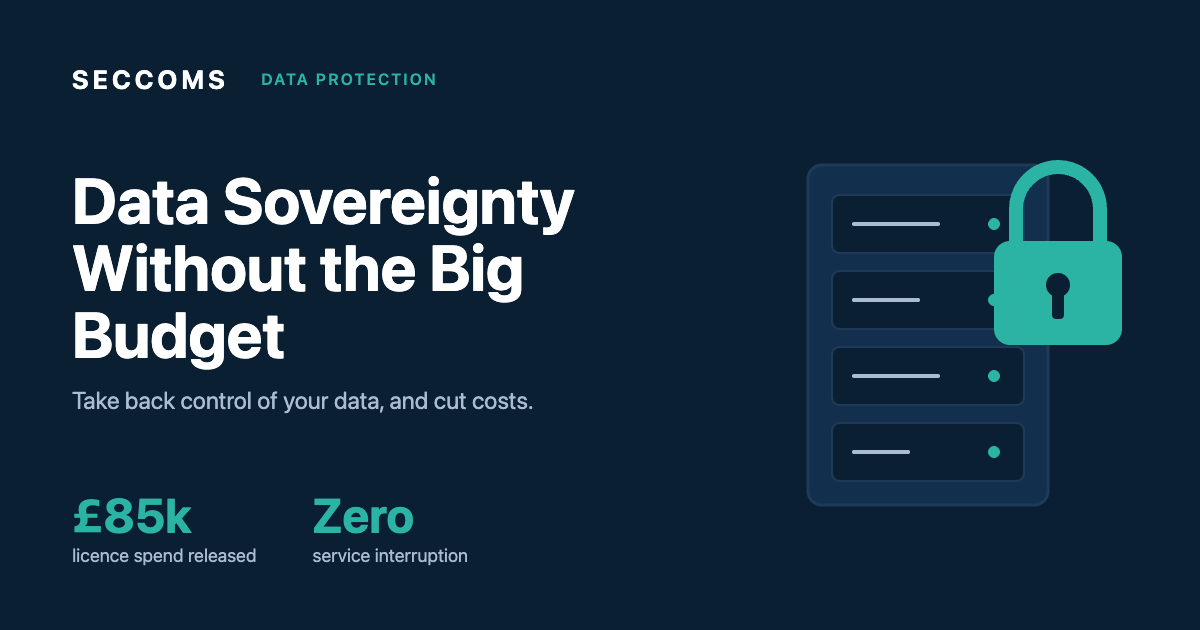
We moved a small enterprise off Microsoft Office onto open-source Nextcloud with no interruption to service, and freed up £85k of licence spend.
More organisations are asking a simple question: who actually controls our data? For many, the honest answer is "a supplier in another country, under someone else's laws." Sovereignty used to be a concern for government and defence. Now it matters to charities, professional firms and small businesses too.
The common assumption is that taking back control is expensive. In my experience it can save money.
The migration
I led a migration for a small enterprise from Microsoft Office products to Nextcloud, an open-source collaboration platform they could host and control.
Two results mattered most:
- No interruption to service. Staff kept working throughout.
- £85k of licence spend released, money the organisation could put back into its own work.
What makes it work
Plan around people, not just data. Moving files is the easy part. Calendars, shared folders, permissions and habits are where migrations stumble. Map how people actually work before you move anything.
Run in parallel, then cut over. Keep the old and new platforms side by side long enough to prove the new one. A clean cutover is the reward for a patient pilot.
Security is built in, not bolted on. Self-hosting gives you control, and with it responsibility. Access control, encryption, backup and monitoring have to be designed from day one. My background in DLP and managed security services shapes how I approach this.
Be honest about fit. Open source is not right for every organisation. Some need features or integrations that only a big platform offers. The point is to choose with your eyes open, not by default.
Who this suits
Small and mid-sized organisations, charities and professional firms that handle sensitive data. Especially those that want to know where their data lives and who can reach it.
Thinking about taking back control of your data? Let's talk through the options.