Running a Managed Security Service That Doesn't Leak
Unrecorded change requests, informal escalations and vague SLAs quietly drain an MSSP. Three fixes from running services for around 2,000 customers.
At NTT Security I was responsible for non-standard security solutions across a customer base of around 2,000 organisations. Services included managed firewalls, MDR, EDR/XDR and threat intelligence.
The technology was rarely the problem. The leaks were in the service model. Here are three I fixed.
1. Record every MACD request
Customers received an allowance of Moves, Adds, Changes and Deletes (MACD) with each subscription, such as a set number of firewall config changes. Nobody was formally recording them. Some clients used far more than their allowance, and some engineers ended up working almost full-time for a single customer.
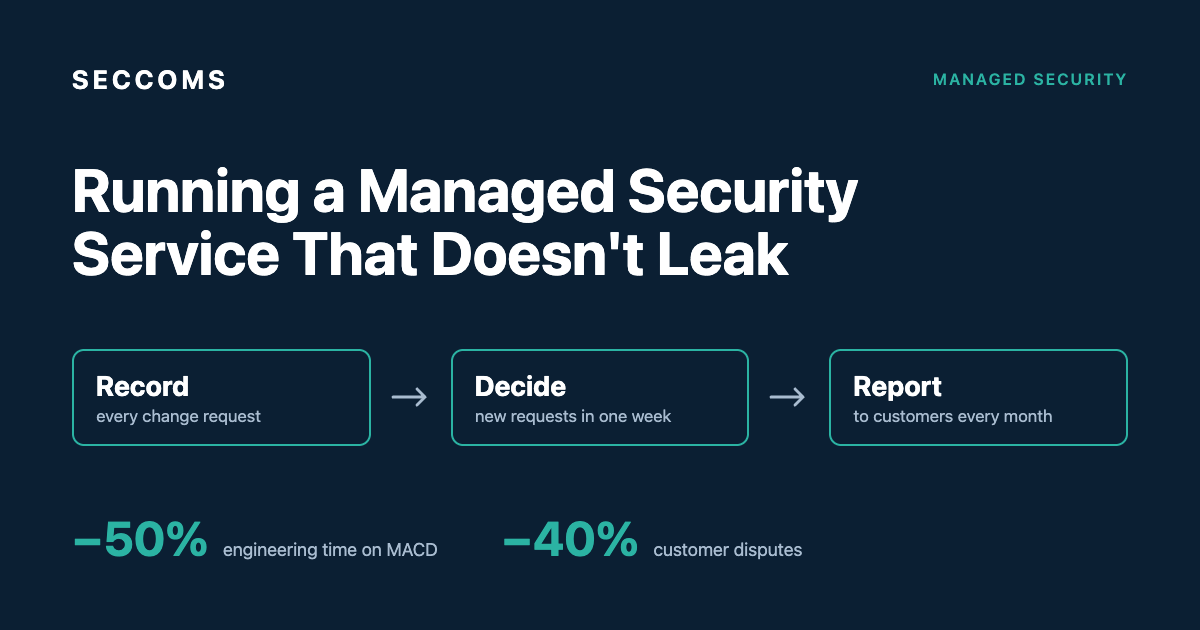
I introduced MACD recording in ServiceNow. Customer representatives were then asked to enforce allowances with their own customers. Engineering time spent on MACD fell by 50%. Onboarding and MACD requests were held to an SLA of over 99%.
2. Give new requests a proper front door
Customers often wanted something outside the standard catalogue. Without a process, those requests went round in circles.
I ran NSTAR, a weekly call with all service stakeholders that gave each request a clear yes or no. The SLA was one week for a decision and one month to implement. Escalations went straight to the Head of Services. Several new services were added through NSTAR, which I then owned and managed.
3. Talk to customers before they complain
Disputes usually come from surprises. Regular monthly Customer Success Manager meetings, with agreed schedules, removed many of those surprises. Disputes fell by 40% against that monthly cadence.
The pattern
Each fix was about making the invisible visible: record it, decide it, report it. An MSSP that does this protects its margins, its engineers and its customer relationships at the same time.
Running a security service that feels like it's leaking? Let's find the gaps.